In conversation at a Chamber of Commerce meeting on Tuesday, my four companions included the 60ish grandson of Eastern European Jewish immigrants. He still spoke Yiddish, and had a different last name from the rest of his family, because his father, 9 years old at the time, spoke some English and was able to correct the spelling when the Ellis Island clerk got it wrong.
A mixed race black woman had an unusually-spelled African given name and a prosaic family name. Why? The immigration clerk didn't like the ethnic name. This woman's daughter wanted the ethnic name back. Mom's reaction? Fine, honey, but I'm not paying the legal fees. Her feeling-- I am not my name.
The hispanic bank manager to my left corrected our anglicized pronunciation of his name. He, in contrast, WAS his name, and wanted it recognized.
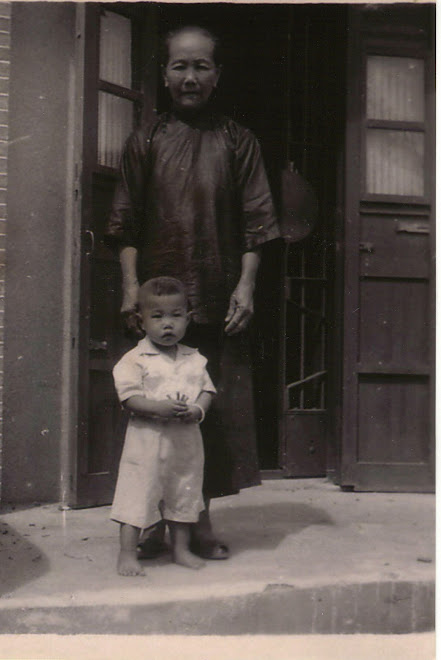
My children have names that reflect the mixed bag of their backgrounds-- Greek (Aspasia) and Swedish (Nelson) and Chinese (Chin, Seng-lim and Nga-jee) and Anglo (Julian and Nora). Perhaps we are not our names, but our names are our history. Everyone at the table had a story that used their names to illustrate something about themselves.
Wednesday, October 29, 2008

Monday, October 27, 2008
Contact
Postcard from the seaman, phone call from the skater. They're far flung but thinking of us, which is the main thing. God how I miss them.
Wednesday, October 22, 2008

My arms ache, my fingernails will never be clean again, but I’m smug and happy with the beauty I have coaxed, with all due respect to Mother Nature, out of this small plot of land. With my garden going on 20, I am continually amazed at both the new panaromas and new details that I find every day.
I’ve always thought of the garden as my canvas. Since I stopped making art for a living more than a decade ago, I have used the garden as a living work of art that is never done. Now for the first time I have both the perspective and the schedule to really treat it that way on an ongoing basis and I find myself going through very similar thoughts and actions in caring for and creating it.
Art happens in the garden much the way it happens in the studio. You have a plan and you execute it, but the result is never quite what you expect.
Kind of like rearing children.
Less room in an empty nest than you might think
My 19-yr-old daughter, who's been living on a theatrical tour for more than a year, will be home for a month in November.
Last time she was home for an extended period, she drove us crazy-- messy, disengaged, expecting to be catered to (at least emotionally), and frankly kind of mean to her mother (that would be me). It's too long to be considered a houseguest, and too short to really integrate her back into systems. She can be somewhat oblivious to her effect on those around her, but is generally charming and great to be around. I just don't want to have to either pick up her shit, or remind her to do so.
So I asked an on-line forum what to do, and the consensus was lay down the rules then chill out and get out of her way.
The best of the comments:
"She's an adult, who's been living "on her own" for about a year now. Expect a lot of frustration if you try to fit her back into the teen-child mold. Let her know you know she's an adult, but also let her know that as family, not a house-guest, she is expected to be responsible. Set guidelines and boundaries up front, in clear terms, without judgments expressed or implied. In terms of expectations in regards to messiness, I'd say let her deal with her own space, but set reasonable requirements for shared spaces, like the kitchen. Try to present your requirements as you would to a potential tenant, not as to a disobedient child."
Life can be so simple sometimes.
Last time she was home for an extended period, she drove us crazy-- messy, disengaged, expecting to be catered to (at least emotionally), and frankly kind of mean to her mother (that would be me). It's too long to be considered a houseguest, and too short to really integrate her back into systems. She can be somewhat oblivious to her effect on those around her, but is generally charming and great to be around. I just don't want to have to either pick up her shit, or remind her to do so.
So I asked an on-line forum what to do, and the consensus was lay down the rules then chill out and get out of her way.
The best of the comments:
"She's an adult, who's been living "on her own" for about a year now. Expect a lot of frustration if you try to fit her back into the teen-child mold. Let her know you know she's an adult, but also let her know that as family, not a house-guest, she is expected to be responsible. Set guidelines and boundaries up front, in clear terms, without judgments expressed or implied. In terms of expectations in regards to messiness, I'd say let her deal with her own space, but set reasonable requirements for shared spaces, like the kitchen. Try to present your requirements as you would to a potential tenant, not as to a disobedient child."
Life can be so simple sometimes.
Monday, September 15, 2008
Why I hate the web
Just waiting for the roofer to show up, on hold with all of my work projects, so I start to surf. Knowing that it's a bad idea, I decide to check out the blog of the daughter of a close friend, and lo and behold, she's using it as a diary and conversation with her friends, she does not want her mother's friend looking at it, and yet now I know it is there. Now it is a scab that I can scratch. Now I know something about her that I don't want her to know that I know. I have removed the bookmark, but I still know that it is there.
The internet gives you the ability, if not outright permission, to snoop. It lets you know what an ignoble person you are, because the ability to do this is irresistible. I never had trouble not snooping in my children's rooms or among their belongings. I've cleaned their rooms without ever feeling a need to find things or pass judgment on items that pass through my hands. I have never read their diaries.
Yet the internet offers a way to look without looking. Pop over to Facebook and see who's talking to them. Drop in at MySpace and check out the page hits. Since I feel sneaky and uncomfortable when I do this, clearly I'm in a morally unpleasant area, and should stop. And yet, who will know?
The internet gives you the ability, if not outright permission, to snoop. It lets you know what an ignoble person you are, because the ability to do this is irresistible. I never had trouble not snooping in my children's rooms or among their belongings. I've cleaned their rooms without ever feeling a need to find things or pass judgment on items that pass through my hands. I have never read their diaries.
Yet the internet offers a way to look without looking. Pop over to Facebook and see who's talking to them. Drop in at MySpace and check out the page hits. Since I feel sneaky and uncomfortable when I do this, clearly I'm in a morally unpleasant area, and should stop. And yet, who will know?
Telling stories
Every family has its myths and stories, they constitute the family's collective memory. It's important to families to have stories that connect you to the ancestors and to each other. Immigrant families treat story-telling in different ways-- either mythical "old country" parables that create a perfect world of tradition and beauty that has been lost, or else a void.
These last believe mostly in the new. "We left the old country and its myths behind". My mother, my grandmother, and my mother-in-law subscribed to the leave-it-be school of immigrant story-telling. We have no old-country stories from these women. All of the stories of the Samioses (Samii?) and the Chins are new land tales, about what happened here in the country that they chose, rather than there in the country that they left. The only thing that really came with them was the food, so Bill and I know nothing about our immigrant heritage except how to eat.
When you don't tell stories, it's hard to get the details to agree. Everyone involved in the original incident must agree-- I said this and you said that, then these things happened in this sequence. The collective must create the stories. The grise tells the mother tells the child, who carries that story at many removes into the future: "This is who we are, because this is who we were."
These last believe mostly in the new. "We left the old country and its myths behind". My mother, my grandmother, and my mother-in-law subscribed to the leave-it-be school of immigrant story-telling. We have no old-country stories from these women. All of the stories of the Samioses (Samii?) and the Chins are new land tales, about what happened here in the country that they chose, rather than there in the country that they left. The only thing that really came with them was the food, so Bill and I know nothing about our immigrant heritage except how to eat.
When you don't tell stories, it's hard to get the details to agree. Everyone involved in the original incident must agree-- I said this and you said that, then these things happened in this sequence. The collective must create the stories. The grise tells the mother tells the child, who carries that story at many removes into the future: "This is who we are, because this is who we were."
Tuesday, August 19, 2008
Knowing people
One does what one gets recognition for. This is why a job is so rewarding; even a bad job. If you do it with reasonable effort, someone notices every single day. You are around people who do the same thing, so you know that your efforts are not only appreciated, but also understood. It is also one of the things that makes internet communities so compelling-- you can find groups of people that share your passions both generally and specifically. There is no sense of the kind of patronizing "support" one gets from friends and family members (oh, Xan's making art, that's so important to her, here's a hug); you don't need hugs or specific praise to know that these people approve, support and understand what you are doing.
When we were young, we found these communities live, by creating cooperative efforts. Galleries, critique groups, activist efforts, community gardens, neighborhood associations, play groups. I wonder, given the ease of finding communities on line, and the safe barrier of anonymity, if people still do this to the same extent.
I find on line communities nearly addictive-- I know if I post a comment or make a journal entry or put up a picture here and here, someone who shares my interest in or love for this thing will see it, and maybe even tell me why they liked it. I don't need to hear from them directly; I can tell from the page views if people have looked at. An irresistible combination: love and statistics.
I think this is what motivates the near-frenzy of young people to get away from their parents. A parent's approval is suspect, and tainted. The approval and support does not spring from shared passion or understanding, but from the uncritical stance of love. It cannot help but feel belittling and condescending. Your parents' pride excludes them from your community.
When we were young, we found these communities live, by creating cooperative efforts. Galleries, critique groups, activist efforts, community gardens, neighborhood associations, play groups. I wonder, given the ease of finding communities on line, and the safe barrier of anonymity, if people still do this to the same extent.
I find on line communities nearly addictive-- I know if I post a comment or make a journal entry or put up a picture here and here, someone who shares my interest in or love for this thing will see it, and maybe even tell me why they liked it. I don't need to hear from them directly; I can tell from the page views if people have looked at. An irresistible combination: love and statistics.
I think this is what motivates the near-frenzy of young people to get away from their parents. A parent's approval is suspect, and tainted. The approval and support does not spring from shared passion or understanding, but from the uncritical stance of love. It cannot help but feel belittling and condescending. Your parents' pride excludes them from your community.
Subscribe to:
Posts (Atom)