One does what one gets recognition for. This is why a job is so rewarding; even a bad job. If you do it with reasonable effort, someone notices every single day. You are around people who do the same thing, so you know that your efforts are not only appreciated, but also understood. It is also one of the things that makes internet communities so compelling-- you can find groups of people that share your passions both generally and specifically. There is no sense of the kind of patronizing "support" one gets from friends and family members (oh, Xan's making art, that's so important to her, here's a hug); you don't need hugs or specific praise to know that these people approve, support and understand what you are doing.
When we were young, we found these communities live, by creating cooperative efforts. Galleries, critique groups, activist efforts, community gardens, neighborhood associations, play groups. I wonder, given the ease of finding communities on line, and the safe barrier of anonymity, if people still do this to the same extent.
I find on line communities nearly addictive-- I know if I post a comment or make a journal entry or put up a picture here and here, someone who shares my interest in or love for this thing will see it, and maybe even tell me why they liked it. I don't need to hear from them directly; I can tell from the page views if people have looked at. An irresistible combination: love and statistics.
I think this is what motivates the near-frenzy of young people to get away from their parents. A parent's approval is suspect, and tainted. The approval and support does not spring from shared passion or understanding, but from the uncritical stance of love. It cannot help but feel belittling and condescending. Your parents' pride excludes them from your community.
Tuesday, August 19, 2008

Saturday, August 16, 2008
The Matriarch
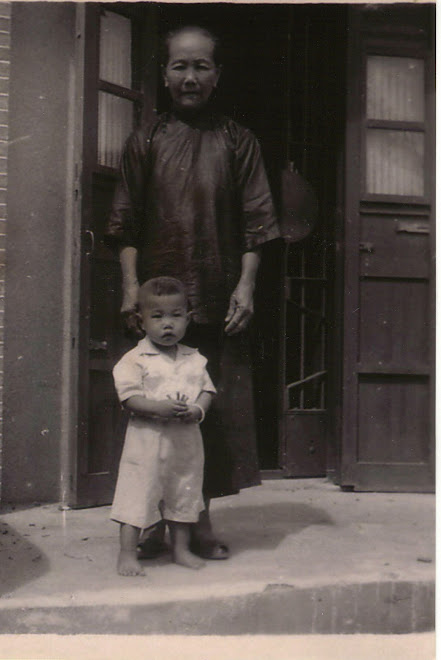
What makes a matriarch? Is a matriarch the oldest female in the family, or the wisest, simply the one who usurps the role? We often conflate age and wisdom in our society, possibly because no one ever feels quite "wise," but it seems safe to assume that age confers wisdom. I think my own mother would have resisted the role of matriarch; it would not have appealed to her sense of the ephemeral. Julia, Liz's mother, made a classic old-world matriarch, but probably just because she was Old World right down to the accent, the home-cooked Hungarian meals, and the house dress persona. We all try to shoehorn May into the role, but she also resists it. This leaves me or Liz. Or really it just leaves Liz, because I think she covets the role. Which is maybe what makes a matriarch.
The concept of the matriarch, the crone, the wise old woman is very appealing. I am too young for this role, of course, and don't have enough of a satellite system, so to speak-- no young 'uns, and not much of an extended family. (Which brings up the other question of how large your tribe needs to be before it requires a matriarch.) I'm not sure people would really view me this way either. I suspect I am headed more towards Crazy Old Lady than Wise Old Lady.
The matriarch is the unanswerable Mother, the person with the final say. This is the appeal-- that someone can say- stop. Someone can say- do. That someone actually has the final answer and the right to an expectation of obedience, or at least compliance. It is this expectation that confers the power of the Matriarch, and by extension the wisdom. This is a feedback loop that reinforces the power-- if I give you power over me, I need to justify that with a belief in your wisdom, which gives you power over me.
The concept of the matriarch, the crone, the wise old woman is very appealing. I am too young for this role, of course, and don't have enough of a satellite system, so to speak-- no young 'uns, and not much of an extended family. (Which brings up the other question of how large your tribe needs to be before it requires a matriarch.) I'm not sure people would really view me this way either. I suspect I am headed more towards Crazy Old Lady than Wise Old Lady.
The matriarch is the unanswerable Mother, the person with the final say. This is the appeal-- that someone can say- stop. Someone can say- do. That someone actually has the final answer and the right to an expectation of obedience, or at least compliance. It is this expectation that confers the power of the Matriarch, and by extension the wisdom. This is a feedback loop that reinforces the power-- if I give you power over me, I need to justify that with a belief in your wisdom, which gives you power over me.
Monday, August 4, 2008
Time
Today is the 61st anniversary of my parents' marriage. I cannot say "my parent's 61st anniversary" because that seems to imply a continuing relationship. I would better say, "my parents got married 61 years ago today," which seems to put it in its proper context of an event and consequence that were and remain in the past.
I don't know the anniversary of their divorce. 1976? So my father has been not-married to my mother longer than he was married to her. What does that mean, when one life passage exceeds another, related one. I have been without my mother longer than I was with her. I have lived with Bill longer than I lived without him. I have known Bill longer than I knew my mother.
I don't know Robert and Marilyn's anniversary, but I know that they have been married 17 years. If my father lives to age 91, he has the potential for being married to Marilyn longer than to my mother; this bothers me. I want my mother to be the most important relationship in his life. Of course, I'm not really sure if that was true, even when it was on-going. So I suppose what I want is an understanding that our family was the most important relationship in his life.
It comes down to this: you should not know anyone longer than you know your mother. The family you create, with your spouse and your mutual children, should be the central one in your life. You cannot replace these relationships with new ones, because shreds of the old one linger.
I don't know the anniversary of their divorce. 1976? So my father has been not-married to my mother longer than he was married to her. What does that mean, when one life passage exceeds another, related one. I have been without my mother longer than I was with her. I have lived with Bill longer than I lived without him. I have known Bill longer than I knew my mother.
I don't know Robert and Marilyn's anniversary, but I know that they have been married 17 years. If my father lives to age 91, he has the potential for being married to Marilyn longer than to my mother; this bothers me. I want my mother to be the most important relationship in his life. Of course, I'm not really sure if that was true, even when it was on-going. So I suppose what I want is an understanding that our family was the most important relationship in his life.
It comes down to this: you should not know anyone longer than you know your mother. The family you create, with your spouse and your mutual children, should be the central one in your life. You cannot replace these relationships with new ones, because shreds of the old one linger.
Thursday, July 31, 2008
Gardening

I grew my garden in lockstep with my family. We moved in to a vast expanse of grass in 1986 (actually a vast expanse of snow, since it was December). For a while the garden grew with the family—add a child, add a flower bed. Five pregnancies later I had a full garden (although only two children—the goddess was kinder to the yard than to the pregnancies).
As the children grew in complexity so did the garden, adding vegetables, trees, more flowers, patios and a pond. The children are grown and gone and the garden is grown yet comes back every year, a lovely metaphor on the nature of parenting adults.
Friday, July 25, 2008
Second guesses
How do you know which things were right and which things were wrong. Our kids seem great-- engaged and engaging, and moving on with their lives. But what if we'd done X instead of Y? Should I have held my temper, or demonstrated it with less sound (if not less fury)? Should Bill have loosed his?
What is the cause and effect, and how do you trace it. What is the provenance of Nga's heedlessness, or Seng Lim's lack of drive. Was Bill underambitious or just realistic? Did I sacrifice for my family or use them as a convenient excuse for my failure? Were we born like this, or are we victims of our parents' failings?
What is the cause and effect, and how do you trace it. What is the provenance of Nga's heedlessness, or Seng Lim's lack of drive. Was Bill underambitious or just realistic? Did I sacrifice for my family or use them as a convenient excuse for my failure? Were we born like this, or are we victims of our parents' failings?
Sunday, July 20, 2008
Help
What is the nature of a partnership? I see the partnership of marriage as a braid-- one piece holds the other in place. Remove one and the whole thing unravels. So each piece needs the other to function; the parts cannot create a whole without this mutual knowledge and help.
If one partner is disabled or unavailable in some way, the other ought to be able to step in without request or instruction. Your cannot require of one partner the burden of knowledge while not accepting your equal responsibility to maintain that knowledge. Correspondingly, each partner must allow the other to create functionality in their own way. This means not only letting your partner achieve an outcome on their own, but also that you cannot insist that someone tell you how to do something.
The need for your partner to "be there for you" is primal, and I think for parents born of the knowledge that you will die and leave your children. Even as the parent of an adult I fear the idea of my children's lives without me. It is very hard to live without your parents, although it is everyone's fate. If my partner is not there for me, will he be there for my children? If my children and my partner don't understand how I do things, how will they learn to do things for themselves?
If one partner is disabled or unavailable in some way, the other ought to be able to step in without request or instruction. Your cannot require of one partner the burden of knowledge while not accepting your equal responsibility to maintain that knowledge. Correspondingly, each partner must allow the other to create functionality in their own way. This means not only letting your partner achieve an outcome on their own, but also that you cannot insist that someone tell you how to do something.
The need for your partner to "be there for you" is primal, and I think for parents born of the knowledge that you will die and leave your children. Even as the parent of an adult I fear the idea of my children's lives without me. It is very hard to live without your parents, although it is everyone's fate. If my partner is not there for me, will he be there for my children? If my children and my partner don't understand how I do things, how will they learn to do things for themselves?
Sunday, July 13, 2008
Guessing games
How do you know what your children will learn?
My mother wanted us to learn self-reliance. She told me once how proud she was at the lack of connection between us-my father, my brother, her and me. She felt she had achieved her purpose in making us "just four people who happen to share a house."
But I did not learn self-reliance from this. I learned to hold with all my might to my family, whether they wanted to be held or not. I learned that I wanted to teach my children that loyalty to the family comes first, and that family is the most important thing in their lives.
But I don't think my children learned this. I think they learned that family is a stranglehold to be resisted. My son fears commitment will tie him to a life he doesn't want. He doesn't seem to feel, as I do, that commitment and lifestyle do not proceed in lockstep, but that one can inform and support the other. My daughter uses commitment as a bludgeon, a weapon, to get her way. "Thwart me and I will withhold myself."
Of course, these outcomes are my worst nightmare-- one child running as fast as he can from family commitment, and another threatening the same thing in order to make my own commitment stronger. Which is, of course, a pattern in my life, of loved ones and friends using my loyalty against me, and punishing me with their absence, physical or emotional, when I demand a return in love and loyalty.
Will my children punish me with distance, or reward with me with proximity? What price will I have to pay?
My mother wanted us to learn self-reliance. She told me once how proud she was at the lack of connection between us-my father, my brother, her and me. She felt she had achieved her purpose in making us "just four people who happen to share a house."
But I did not learn self-reliance from this. I learned to hold with all my might to my family, whether they wanted to be held or not. I learned that I wanted to teach my children that loyalty to the family comes first, and that family is the most important thing in their lives.
But I don't think my children learned this. I think they learned that family is a stranglehold to be resisted. My son fears commitment will tie him to a life he doesn't want. He doesn't seem to feel, as I do, that commitment and lifestyle do not proceed in lockstep, but that one can inform and support the other. My daughter uses commitment as a bludgeon, a weapon, to get her way. "Thwart me and I will withhold myself."
Of course, these outcomes are my worst nightmare-- one child running as fast as he can from family commitment, and another threatening the same thing in order to make my own commitment stronger. Which is, of course, a pattern in my life, of loved ones and friends using my loyalty against me, and punishing me with their absence, physical or emotional, when I demand a return in love and loyalty.
Will my children punish me with distance, or reward with me with proximity? What price will I have to pay?
Subscribe to:
Posts (Atom)